
Experience stories
Vira’s story: Finding home in Estonia

Vira moved from the US to Estonia in March 2018 with her family, without any expectations. They wanted to leave the US for a while to give their kids another perspective on the world and get the perks of spending more time in nature and reducing their commuting time.
Vira and her husband began searching for new opportunities in the US and abroad. Her husband applied for various jobs and eventually had two options: moving to California or to Estonia. “And we’re like, let’s just try Estonia. The worst thing that can happen is we hate it and waste some time and money,” she says.
Vira and her husband were both child immigrants, so they knew what it was like to move between countries as children. “I was born in Ukraine, and my husband was born in Cuba. We knew that moving is much easier when kids are not in school yet,” she says. When Vira’s family moved to Estonia, her younger son was two and a half years old, and her older son was five.
Vira agreed with her husband that they would not paint a full picture of life in Estonia. “We made a list of things we wanted to gain and things we wanted to leave behind in our lifestyle. That was how we measured whether coming here was a good decision,” she explains. They wanted to spend more time in nature and less time on everyday commuting, which were the two main aspects of life in the US they wanted to change.
“We were worried about the transition. What if my husband’s job didn’t work out during the trial period on the other side of the world? We didn’t know anyone here, and we had never visited Estonia. We hoped to settle and find a community. The language obviously was a question,” Vira says.
A fresh start in Estonia
Vira is a freelance writer and runs her own company, which made settling in easier for her family. This allowed her husband to focus on starting his new job.
“In theory, going to the grocery store sounds simple. In reality, the store and the products are different, and I couldn’t read the signs. I spent 20 minutes in one aisle with Google Translate. Weirdly, grocery shopping was the hardest part,” she says.
Moving to Estonia in March made the transition easier. “I always tell people: if you can choose when to move to Estonia, do it in March. We got the tail end of winter – there was still snow, but it was already sunny, and the days were getting longer. If you move in summer, it’s beautiful at first, but two months later you’re thinking, ‘What is this?” Vira explains.
Thankfully, the company where Vira’s husband got a job helped with settling in, relocation and paperwork. “The company gave us an apartment for the first two weeks, which gave us time to decide which part of the city we want to live in and find a rental apartment. One thing I appreciated a lot was the free public transport,” Vira says.
Adjusting to Estonian kindergarten
In April, the children went to an English-language kindergarten before starting an Estonian-language kindergarten in August.
“It was difficult, because there were many changes at once. Before kindergarten, they heard Estonian only while we were out. It really helped that the boys were in the same mixed-age kindergarten group, so they could rely on each other. One of the teachers also spoke English and helped them at the beginning,” Vira says.
“It was interesting to see how differently they adapted. One of the boys tried to communicate in any way he could – by pointing or using the words he knew. The other relied more on a friend who spoke a little English. They each found their own way to communicate,” she says.
After six months in Estonian kindergarten, the boys were already comfortable speaking in Estonian. “We would go to the park, and they would make friends in Estonian. They were simply living their lives.”
Mastering language without pressure
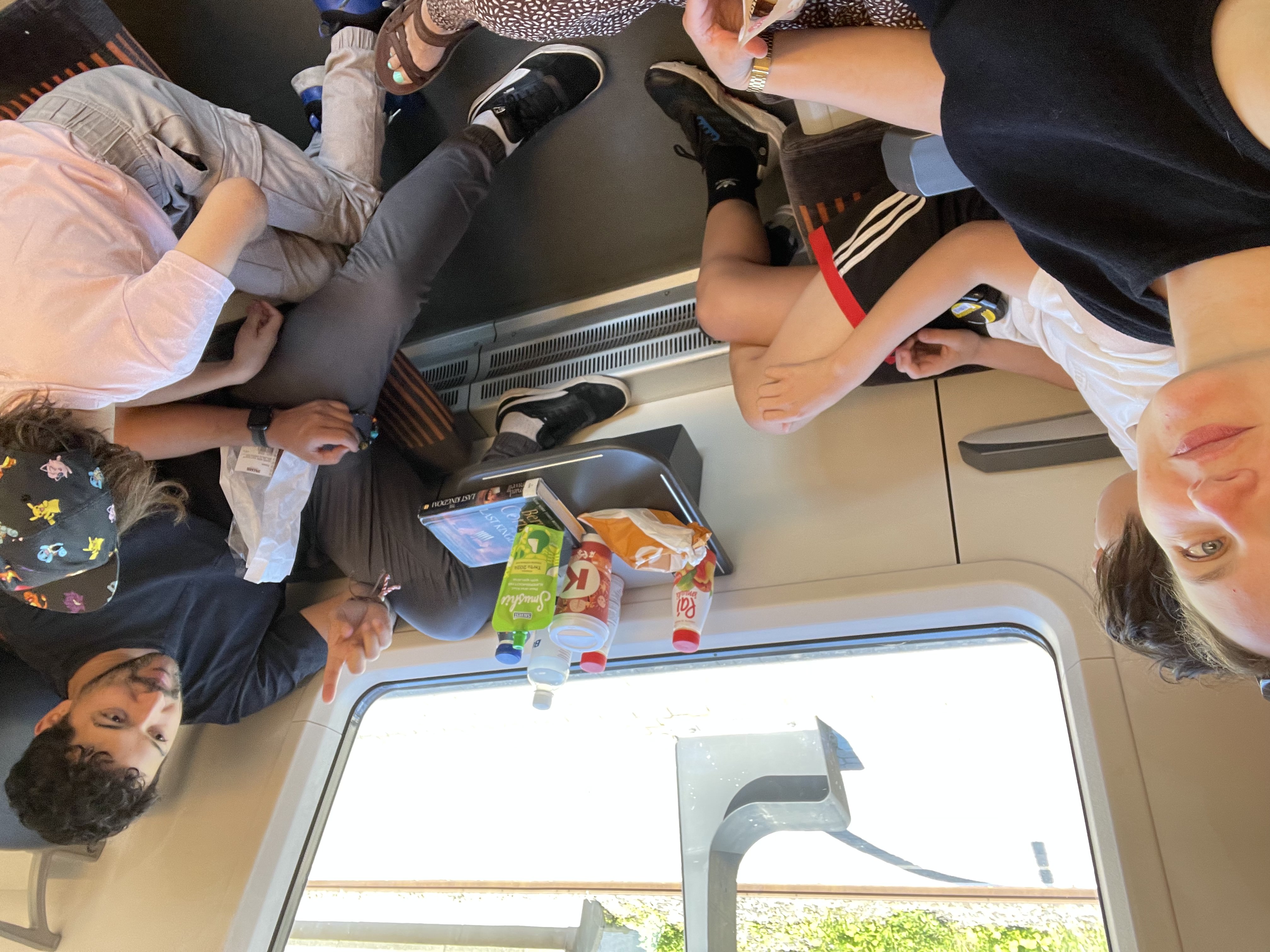
Vira’s biggest goal was to make sure her sons could relax when they came home. “I trusted the process and believed that they would master Estonian best in kindergarten. I didn’t want to put any pressure on language learning because I knew they would be tired after spending the day in a different language environment,” she says.
By the time the boys started school, they had no problems speaking or understanding Estonian. “In third grade, my older son had to take the version of the national Estonian and math tests intended for children whose first language isn’t Estonian. At first, he felt offended because he felt he could take the same test as everyone else. Afterwards, he was glad he didn’t, because it had so many more questions,” Vira says.
“At first, I thought my younger son would manage Estonian more easily because he was younger when we moved here. It turned out he makes more mistakes than his older brother did at the same age. The grades are good, and his mistakes are the same ones Estonian children make, so they’re not related to being a foreigner,” she explains.
Language in Everyday Life
Vira’s family still mainly speaks English with neighbours and colleagues. “I speak some Russian, but my Estonian is limited to basic phrases. If I need to get something done or ask a question, we usually switch to English. I understand Estonian a lot more than I can speak. I took an A1 class in the first year we were here. Parent meetings, communicating with the kids’ coaches, and my folk-dance group helped me to understand Estonian more,” she says.
At home, the family mostly speaks English. “The children still understand some Ukrainian and Spanish, and we are trying to bring it back, but it’s harder now that they are older. I am hopeful because some of it is still there,” Vira says.
“I love Estonians because they say that their English is not so good and then speak like they’re writing a master’s-level thesis in English. It’s almost too easy to get by in English, and I think that’s an issue. People are so accommodating and switch to English so quickly. If I try to speak Estonian in a café, for example, and I struggle, the staff usually switch to English. I sometimes must insist that they let me speak Estonian,” she explains.
Moving to Estonia as a specialist for an international company, where the working language is English, makes it difficult to learn Estonian. “Your friends are often other foreigners, so it’s easy to end up in a bubble. My experience has been different because I have more Estonian friends, and dealing with my sons’ school has pushed me to use Estonian more,” Vira says.
Advice for Families Moving to Estonia
Vira advises families planning to stay in Estonia for more than two years to enrol their children in an Estonian-language school or kindergarten. “It really helps if children learn some Estonian before starting school. Even if they stay for less than two years, it’s still a good decision to feel settled here,” she says.
She also recommends seeking out schools with experience supporting children from different language backgrounds. “I only found out about these schools at a meeting for expats and immigrants. I had no idea that there were schools with this type of experience. I think it would be helpful if families knew about these options,” Vira says.
She believes more practical information about the Estonian school system would also make the transition easier. “School meetings can be difficult when you’re the only parent who doesn’t speak Estonian. There are also many things locals may take for granted—how classes are organised, how assessments work, or even what school supplies to buy. Sometimes you don’t even know what to ask. I remember shopping for first-grade supplies and not understanding the list, even with Google Translate. In the end, I asked someone in the store to help me,” she says.
From Kenya to Estonia: starting a family in a new country

Estonia and Kenya have many differences, but an exciting job opportunity brought Faith and Ephraim to Estonia. They have discovered the unique features of Estonia, made friends and learned Estonian. Together they are raising a child who learns Estonian, Swahili and English and has friends from different nationalities.
What brought you to Estonia?
Faith: My friend suggested a job opportunity here in Estonia, but we didn’t know much about Estonia. From what I could see on the pictures, it was beautiful, the red roofs and everything. We arrived in Estonia on July 1st, 2022.
Ephraim: The first time we heard about Estonia was in autumn 2021 when President Kersti Kaljulaid visited Kenya. It caught the attention of Kenyan people. This year Estonia will open its embassy in Kenya.
What was your first impression of Estonia?
Faith: Coming from a country where there's a lot of people, Estonia felt different. Solely in the city centre of Nairobi, the capital of Kenya there lives 3 million people. As an introvert, when I came here and got to know this small community, I felt that this was a place meant for me.
You never forget your first winter. I was surprised by how much I enjoyed it, because being outside feels fresh and refreshing. It just feels nice. I didn’t expect that I would adapt to it so well.
Ephraim: I think the advantage we had was that my wife's office was not very far from our first home in Tallinn. It was literally behind the house. Even though it was a tough winter, we felt good. I really enjoyed the snow, even though it took us a bit of time just to get the right shoes, jacket and gloves.
What has been your experience with the Estonian language?
Faith: It wasn't easy at first. The classes I had, there was no translation to English. You must figure it out as you go. I'd say Estonian is unique. But I related to it, because the way Estonians pronounce every letter in the word – it is like Swahili. Once you get that momentum it becomes easier for you to learn Estonian. I have now finished Estonian A1 level.
Ephraim: I had a similar experience. While learning in my A1 Estonian class and I had to read, they asked me if I have learned Estonian before – they said my pronunciation is very good. Now I'm finishing my A2 Estonian.
Our daughter has picked up the Estonian language very fast since going to kindergarten. And she has supported our language studies.
When did your daughter start kindergarten?
Ephraim: As soon as she turned 18 months old. It was in August 2024. She's picked up Estonian fast and is fluent right now. In kindergarten she just switches to Estonian and she's talking very nicely. Initially when she started learning it, she'd come home and she'd talk to us and tell us things in Estonian, and we had no idea what she was telling us.
The other day I was studying for the A2 exam, and I was reading the questions aloud. I didn't know she was listening, but she started to answer me.
And how much time took it for her to start speaking Estonian?
Faith: Within a year, I think. Because she was learning Estonian every day. She picked it up quite fast. When she's in kindergarten she talks to the teacher and other kids in Estonian. I remember teachers told us already at the beginning that she will learn Estonian fast because she liked to repeat the Estonian words and sentences.
How well does she speak Swahili and English?
Faith: At home we speak Swahili mostly. Although she understands Swahili and speaks a little, she mostly responds in English.
Do you have some tips for other parents on how to make the transition to kindergarten easier?
Ephraim: Being patient with the child is key. When your child starts kindergarten, you will have time to help them become familiar with the kindergarten. At first, you can go together to the play area and spend time playing with them. Gradually, you can begin leaving them on their own for a few minutes at a time, then for longer periods. Eventually, your child will become comfortable being there without their parents.
The next step is eating. In kindergarten children have breakfast and lunch. At the beginning our daughter ate at home, but then she refused to eat breakfast at kindergarten. At some point we decided that she should eat breakfast at kindergarten. Also, food itself is something to think about too. At home she ate pureed food and we fed her. At kindergarten children eat solid food by themselves. Therefore, it is important to get your child used to real food and for them to be able to eat independently.
Food at kindergarten might be quite different from the food eaten at home. We were told what was on the menu at kindergarten and introduced the same food at home as well.
How has she adjusted to kindergarten?
Faith: She has quite a lot of friends at kindergarten. I have a Whats App group with a few parents and sometimes we get together on weekends or let our children play around the kindergarten before it is closed during pickup. Our daughter has three best friends who are from different nationalities, but they all speak Estonian and understand each other well.
In the beginning she did not feel comfortable at playgrounds and to go play with other children. Therefore, I avoided crowded places. I think that meeting other children would have helped her to get comfortable around other children earlier. This would also have been useful when adjusting to kindergarten. That is something I recommend to new parents.
What are your hopes for the future?
Faith: Living and studying in Estonia gives our daughter a good opportunity to develop her skills. Here she has a better future in terms of education.
Ephraim: Estonian education system is ranked among the top globally, especially for STEM (science, technology, engineering, mathematics). Our focus is for her to access the highest level of education available. Here she can learn more subjects than in Kenya. Our child loves music and arts and in Estonia there are different hobby schools to choose from.
I didn't realize how important it was for her starting kindergarten at 18 months. Back home, kids start kindergarten at the age of four. I realized the impact a few months ago when I was talking to my friend. He could hear my child talking and he was so surprised how well my child was talking compared to his kid who is only three months younger than ours. That made me realize how important it is to start kindergarten early. Children learn very quickly and gradually become more independent. They learn how to eat on their own, get dressed and express themselves.
Are there more differences between kindergartens in Kenya and in Estonia?
Ephraim: The curriculum is different, but the number of kids in each group differs too. There are up to 24 children in one kindergarten group in Estonia. In Kenya there are 50-60 children in one group, but only one teacher. In Estonia, each group has a teacher and one or two assistant teachers. Here we have an annual meeting with the teacher to discuss our child's development and progress. I appreciate that children are taught many practical life skills, such as road safety, etc.
Faith: Our daughter has already learned so many things. She knows numbers, shapes and colours. She speaks Estonian and is fluent enough to have conversations. But children of the same age in Kenya are still at home.
From Brazil to Estonia: Dyego’s family journey to a new life in a new country

When Dyego left Brazil in May 2018, he carried expectations, quiet fears, and determination to build a better future for his children. An exciting job opportunity had opened the door to Estonia, which he chose to walk through alone at first, leaving his wife and two children temporarily behind.
“I was looking for better job opportunities, a better quality of life for my children, and to have the experience of living outside Brazil,” he says. In June 2019, a year after Dyego moved, his family joined him. His daughter was 11, his son was 8, turning nine that August. What followed was a journey of adaptation – linguistic, cultural, and emotional – that would test them all.
Arriving with hope and worry
For Dyego, the decision to move was both exciting and daunting. Despite careful research, uncertainty lingered. “I was afraid if the salary would be enough,” he admits. “Even though I did quite good research, I was still afraid.”
Yet, once in Estonia, he found adaptation smoother than expected. “As my mind was open to all the experiences, I feel that almost everything was easy to adapt.”
There were small but telling challenges. “The most challenging part was not having the medicines I was used to having in Brazil,” he recalls. “But eventually I got used to it.”
At work, English became his bridge. He communicates daily in English at his workplace and initially used it with his landlord and neighbours as well. In his first apartment building, neighbourly contact was minimal. “My colleagues told me that this is very common in Estonia – that you know who your neighbours are and greet each other, but often that is the limit of communication.”
Life shifted when the family moved to a private housing area. “Now there is more communication with the neighbours,” he says. “Our immediate neighbours also have children. We communicate and meet very often, and I am happy about that.”
Children thrown into a new language
For Dyego’s children, the transition was far more complex. Like their parents, they had no introduction to Estonian before arriving. Their first encounter with the language was in an Estonian school.
“Their native language is Portuguese, and they had studied English for only a year before moving. Suddenly, they were navigating school life in a completely unfamiliar language,” Dyego explains.
“At the time they started learning Estonian, everything seemed difficult,” he says honestly.
The support of their school, Tallinna Südalinna Kool, proved essential. The school provided extra Estonian classes after regular hours – support that Dyego credits as crucial in those early days.
COVID-19: a new layer of difficulty
Just as the children were finding their footing, the COVID-19 pandemic disrupted everything. Distance learning magnified the language barrier.
“Learning Estonian was very difficult, especially when COVID-19 hit the world,” Dyego says. “For my children, it was very hard to keep focus while studying online in a totally different language.”
There was also emotional resistance. “Especially for my daughter, who was not completely enjoying staying in Estonia.”
Making friends became even harder during lockdown. When in-person classes resumed, connection came first through shared languages.
“It was easiest for them to communicate with classmates who spoke Portuguese,” he explains. Some classmates were from mixed Estonian-Brazilian families and helped ease the transition. Over time, Estonian began to replace Portuguese in conversations.
Facing bullying and building resilience
Like many children adjusting to a new country, Dyego’s children encountered moments of bullying. “I think bullying occurs in every school, but it is not always intentional,” he reflects. “Sometimes children unintentionally say things that hurt others.”
Rather than stepping in immediately, Dyego encouraged independence. “I discussed with the children that in case of bullying, as well as other problems, they should try to solve them themselves, for example, by talking to other students or asking for help from teachers if necessary. This way, they learn to be independent.”
He emphasizes the importance of open dialogue at home. Honest conversations, he believes, help children both cope with hurtful situations and avoid unintentionally hurting others themselves.
Learning Estonian
Dyego himself does not speak Estonian fluently, which limited how much he could directly support language learning at home. “Unfortunately, I didn't have much to do, as I also don't know Estonian,” he says. Still, he invested in additional private lessons to complement school support.
The children showed little interest in passive exposure, such as watching Estonian-language television. Their progress came primarily through schoolwork and daily interaction. Today, the results are striking.
“I consider both my children fluent in Estonian,” Dyego says proudly, though he notes their differences. “My daughter feels that it is easier now to speak Estonian than English with friends. She speaks very well.”
His son, on the other hand, has a more analytical grasp. “He knows how to speak, but he knows the grammar better than he speaks. He needs to push himself to speak more in Estonian with friends.”
In a quiet but powerful shift, the children now move between languages with ease – sometimes more comfortably than their father.
Advice for other families
Looking back, Dyego is realistic but hopeful. Integration, he says, is neither automatic nor effortless.
“Parents need to understand what they are expecting from the future,” he advises. “If they feel that Estonia is a long-term plan, my suggestion is to keep the kids in an Estonian school.”
He encourages parents to prepare for challenges, including possible bullying and cultural misunderstandings. Children are different everywhere, he notes, and curiosity can sometimes be expressed in ways that feel harsh to newcomers.
Still, his message is ultimately one of resilience. “With resilience and support, foreigners will make friends and conquer their space in the Estonian society,” he says. “It is not easy. It demands effort, but it pays off.”
From a solo arrival in 2018 to raising bilingual children who now call Estonia home, Dyego’s story is not just about relocation. It is about adaptation, perseverance, and the quiet courage it takes to build a life in a new language.

Tallinn Lilleküla Gymnasium’s experience in creating a school environment that supports language learning
Starting school in Estonia can be a challenge for a child arriving from abroad: a new school, new friends, and learning in a new language. Liis Olt, the head teacher at Tallinn Lilleküla Gymnasium, says that while language learning takes time, a supportive school environment and consistency lead to success. It also helps children learn Estonian if they have opportunities to use the language outside of school, whether that means attending a hobby club in Estonian or watching their favourite cartoons in Estonian.
How can parents support their child’s learning at home? What materials or activities do you recommend for students to practice Estonian outside of school?
Our principle is that teaching Estonian is the school’s responsibility. We do not expect parents to fulfil this role, especially if they themselves do not know enough Estonian. However, the parent’s role is very important in fostering a positive attitude, encouraging the child and supporting them in learning a new language.
We recommend that families encourage their children to watch age-appropriate Estonian-language cartoons and children’s programs. If a parent speaks Estonian, they could agree with their child to communicate in Estonian at home for part of the day, for example, in the mornings after the child has woken up. We also recommend that the child participates in hobby groups or training sessions in Estonian, as this supports language development, expands their social circle, and broadens their vocabulary.
Have you created any supporting learning materials, and if so, what kind?
There are sufficient high-quality learning materials for learning Estonian, so teachers generally do not need to create their own materials and can use existing resources.
How do you communicate with parents whose native language is not Estonian?
Our school has staff members who speak various languages (e.g., English, Ukrainian, Spanish). If a parent speaks one of these languages, we involve a colleague who is proficient in that language for communication. If no common language can be found, communication takes place through an interpreter, who is usually found by the parent. In practice, however, most communication takes place in English. We provide feedback on the child’s development primarily during progress meetings, but we also communicate with parents as needed.
What are parents’ expectations when communicating with the school, and what does the school expect from parents?
Parents’ main expectation is that their children receive an education on par with that of students whose native language is Estonian. The school expects parents to be cooperative and to trust the school.
It is also important that parents understand how time-consuming language learning is. Mastering a new language does not happen overnight and requires patience and consistent effort.
Our experience has shown that open communication and parental support for the child’s participation in Estonian-language activities outside of school are most effective.

What support services does your school offer to students who have moved to Estonia?
We offer all students arriving from abroad the opportunity to study Estonian as a second language. We create an individualized curriculum for them, with a primary focus on language learning in the first year.
At the same time, we value students’ native languages and cultures, organize school-wide cultural days, and have designed the physical school environment so that students from other countries feel welcome (greetings in their native languages, opportunities to introduce their own cultures, pictograms, etc.).
Our experience shows that in a supportive school environment and with consistent language instruction, students feel more confident and perform well academically.
What do you do during school-wide culture days?
Our school’s Culture Day has become a special tradition where students of foreign origin can introduce their home countries, cultures, and daily lives. All activities are organized in collaboration with the class, ensuring that each country and culture is presented in a multifaceted way.
It is a day when students share their backgrounds and experiences, and others get to learn about different countries and cultures, thereby broadening their horizons and valuing the diversity of our school community.
Multicultural Groups at the Südameke Kindergarten

Many children at the Südameke Kindergarten speak a first language other than Estonian. Margit Hiiet, the kindergarten’s director, explains how children with different native languages come together to play and learn Estonian.
How quickly do children adapt to the Estonian language in kindergarten?
Our experience shows that children will most quickly start communicating in Estonian with other children. They go play with other children, and in the process, they adapt quickly and begin to acquire Estonian. It seems to me that adapting to the new circumstances is more difficult for parents than for the children. Additionally, I have noticed that children from more distant countries pick up Estonian more quickly.
To help children acquire Estonian faster, we speak only Estonian in the kindergarten. In kindergarten, children don’t study Estonian; they acquire it through daily activities. We speak only Estonian in front of the children, also with their parents. If a parent does not speak Estonian, we use translation apps on our phones, such as Google Translate, in the child’s presence. When the child goes to play, the teacher can speak with the parent in a common language, depending on the teacher’s language skills. We have teachers who speak Russian and/or English.
Together with the parents, we can manage any situation. It is natural for parents to want to better understand how the kindergarten works. We always encourage them to ask questions. It is better to ask questions than to leave them unasked. It is also worth bringing up any concerns right away so they can be resolved quickly.
What has come as a surprise to parents from other countries on kindergarten?
The nature of kindergarten varies from country to country. For some parents, especially those who have moved to Estonia from abroad, it has been a surprise that kindergartens are educational institutions where teaching also takes place. We share the kindergarten’s daily schedule with all parents, which includes specific times for meals, rest periods, and learning activities.
Mealtime can be a challenge at first if a child is accustomed to a different national cuisine. We have also had cases where, at first, the family packed the child’s usual food, but gradually we introduced the child to the food served at the kindergarten. Children are interested in trying new things and adapt quickly.
One thing to keep in mind is the summer break. The kindergarten has a collective vacation, which means it is closed for two weeks. This comes as a surprise to many parents. Most parents plan their own vacations for this time. For those who cannot do so, we will find a temporary spot at another kindergarten.
What is the first step in enrolling a child in kindergarten?
Once a parent has decided to enroll their child in our kindergarten, they fill out an application, which I use to add the child to the kindergarten’s children list. The application can be completed online or in person at the kindergarten. I then explain to the parent how the transition to kindergarten will work. Some parents want to meet and tour the kindergarten before their child starts going there. In that case, we will find a time for that. It is important that the parent receives sufficient information and develops trust in the kindergarten. I have always said that there are no silly questions when it comes to kindergarten. It is equally important that the parent understands that the kindergarten has its own house rules and regulations.
Depending on a parent’s cultural background, some may prefer to communicate directly with the director. I have no objection to that, but you will get answers much faster from a teacher. Since our kindergarten runs in two buildings, I split my time between them and may not be able to answer all questions right away.
That is why I still recommend communicating directly with the teacher. If necessary, we use Google Translate without hesitation, because we simply cannot know every language in the world. I should also mention that sometimes it translates incorrectly, which is funny for everyone, but in the end, we always manage to communicate with each other. I have noticed that parents are increasingly using AI to help them compose messages in Estonian. The main thing is that the parent gets answers to all their questions.
During the first month, we have a scheduled family meeting led by the teacher. The teacher is the one who communicates most with the family. Before the meeting, we give the parents a preparatory sheet so they can prepare for the conversation at home. Through this meeting, we aim to better understand the family’s routines, what the child is accustomed to, and what skills the child has.

At first, children practice attending kindergarten with a parent. This means the parent stays with the child, and they play together in the kindergarten yard. We also encourage the child to play with other children. The parent gradually stays away for longer periods until the child is ready to enter the groups room without them. We do not allow parents in the group room with the other children to prevent the children from missing their parents. Some children adjust very quickly. This often depends on their age. Some children are already playing with others in the group room by the second day. For others, adjusting takes a little longer.
How does the kindergarten prepare to welcome a new child who does not speak Estonian?
Our team is used to having children from diverse ethnic backgrounds. Our kindergarten was originally a Russian-language kindergarten. Later, we added Estonian-language groups. Eventually, we began implementing language immersion, and today we are a transition kindergarten. This means that all our kindergarten groups are Estonian speaking, but there are groups where most of the children’s native language is not Estonian. In recent years, we have had many children who come from different countries and speak different native languages.
When a child from another country joins us, we talk to the children during morning circle that a new child is coming who does not yet speak Estonian, but that we can help them. By now, we have so many children from various places that this is completely normal. I should also add right away that if anyone is afraid of being excluded or bullied, that does not happen here. Of course, children get into arguments with each other from time to time, then make up, get into another argument, and make up again. Children do not fight over nationality or language. The reason is always something that happened during play. For children, it is natural and interesting to have classmates from different nationalities and speak a different first languages.
How many children at the Südameke kindergarten have a native language other than Estonian?
We have children in every group whose native language is not Estonian. Russian is the second-largest language group among them. This group includes both local children and children who have moved to Estonia from other countries. Across the entire kindergarten, we have more children with a different native language than those with Estonian as their first language. Despite this, all children at our kindergarten acquire Estonian. In some groups, this comes more easily, but in groups where most children do not yet speak Estonian, it takes a bit longer.
How is the children’s acquisition of the Estonian language progressing in kindergarten?
The better a child’s development in their native language, the easier it is for them to acquire other languages. Studies show that a child of kindergarten age can acquire several foreign languages. It is important, however, that the child’s native language is spoken at home, as developing it is crucial.
When learning Estonian, it is beneficial for the child to have opportunities to use the language outside of kindergarten as well. For example, if they find a playmate at the playground with whom they can speak Estonian. You can also take the child to the theatre. Children enjoy Puppet Theatre, which is beneficial because the puppets speak Estonian there. Similarly, Estonian-language children’s TV shows are great. It helps the child when they realize they can use Estonian for communication outside of kindergarten as well.
Parents have also asked us about language classes, but I do not see a need for that with kindergarteners. An Estonian-speaking environment and positive emotions are the biggest help. We must also keep in mind that a child needs time to start speaking Estonian. The so-called silent period, where the child understands but does not speak, is a completely natural part of language learning.
I have noticed that children are more successful in mastering Estonian when parents are also willing to try to learn the language. There are also parents who do not learn Estonian, which affects the child. For a child to master Estonian more effectively, it is beneficial to feel the family’s support and encouragement.
What else supports children’s acquisition of the Estonian language?
An extracurricular activity supports the child’s development and learning of Estonian. At the same time, you should ensure that the child has enough time to rest. Small activities that allow children to practice Estonian also support language learning. For example, when you take your child to a café and they can say what they want in Estonian. It is also great when parents praise and encourage their child to use Estonian.
How much should we prepare children for school?
From time to time, we have noticed that parents want to over-prepare their children for school. The expected developmental milestones for children are outlined in the kindergarten curriculum. From time to time, we ask parents to take a step back and check the curriculum to see what their child should be able to do, and we ask them not to get ahead of themselves.
Some children develop faster and do things more quickly, but a foundation must also be laid. This is sometimes overlooked. For example, playing in the sandbox is important for hand development, so that the child can hold a pencil better in the future. If we immediately hand a child a pencil to assess their ability to write letters, then some of the activities that support the child’s development are left undone. We often lack patience because we want everything – and we want it fast.
A child develops at their own pace, after all. For a child to develop, there must also be time that is not filled in for them. This is the time that the child must fill in on their own. Even in kindergarten, we create an environment where children can choose or invent games themselves and interact with one another. To ensure no one is left alone, we encourage children to go play with others. This supports their social skills. In the process, they also learn that not everyone always agrees and what needs to be done to reach a consensus. For example, they agree to play one game first and then another.
What do you do at the kindergarten to learn about other cultures?

Like other kindergartens, we also have ethnic culture days. This is a day when parents and children can introduce their culture. Everyone’s favourites are always the ones where we get to try different ethnic foods. Last year, for example, we had a lullaby day. The children sang their lullabies, and in some cases, a parent sang along too. Some parents and children filmed themselves singing a lullaby from their own culture together, and we watched it together.
We have also had a festival of dances from diverse cultures. This year, each group chose one dance, which the children learned and performed for others at the festival. It was an exciting project because, thanks to the selection process, the children got to explore dances from diverse cultures.
I think adults have a lot to learn from how easily and naturally children adapt to change in a safe environment. Thus, for a child coming to Estonia from a distinct cultural background, it can be an exciting discovery if the adults around them create the right environment and give the child time to develop at their own pace.
Tallinn Südalinna School’s Experience in Teaching Estonian

Many young people for whom Estonian is a second or even third language have studied or are currently studying at Tallinn Südalinna School. Kerttu Mölder-Jevdokimov, the head teacher, shares Südalinna School’s experience on how they support young people in learning Estonian, how they assist parents, and how they introduce the students’ culture and native language to the school community.
Where do you start when a child whose native language is different from Estonian wants to enroll in the school?
In May and June, we hold orientation days for children starting first grade and their parents. During these sessions, we also assess each child's readiness for school. If a child joins the school at another time of the year, we begin with a meeting with the child and their parents. We try to understand the child’s learning abilities, social skills and level of proficiency in Estonian.
Children who have attended an Estonian kindergarten have a certain advantage, as they have acquired basic skills in the Estonian language. If a child does not yet speak Estonian or has limited proficiency in the language, we advise the parents on how they can support their child at home during the early stages of learning Estonian and introduce them to learning materials. Summer is a long period during which it’s possible to acquire a solid foundation of basic vocabulary. Over the years, our school has educated quite a few children who have come to Estonia from all over the world and had never studied Estonian before. Generally, their progress in learning Estonian has been very good, and within just a couple of months, they have begun to speak Estonian at a basic level. By the end of the year, some of them have even achieved better academic results than Estonian children.
There is also a growing number of children with special educational needs. Several useful support services have been established to assist these children. Parents from abroad are usually not familiar with these services, and in many countries, schools do not even have such support specialists. We explain to all parents that they can seek assistance from our support specialists whenever needed. This explanation is necessary because we still sense a certain sense of shame among parents, but in reality, support services are beneficial for the child.
What else is different about the Estonian education system?
The age at which children start school varies from country to country. We have had parents approach us who wanted to enroll their five-year-old in school, as is customary in their country. Here, however, children generally start school at age seven.
Differences in school systems often cause confusion, especially when a child’s age would place them in third grade in Estonia, but in another country, they would already be in fifth grade. Parents usually find this very difficult to accept, but it’s important to understand that the grade level isn’t the deciding factor—education systems simply differ.
Parents from other countries often believe that they must pay for school. We have repeatedly assured some parents that there are no tuition fees. Nor do you have to pay for textbooks or workbooks. You will need to purchase notebooks, pencil case supplies, art supplies, and sports clothes for your child. We provide parents with a list of necessary school supplies, to which we’ve added pictures to make it easier to buy the right items. We’ve received feedback that the pictures accompanying the list have been helpful.
Parents should make sure their child has all the necessary items with them when coming to school. It’s also important to arrive on time. We’ve encountered different attitudes toward attending school. There have been situations where children have arrived at school an hour or two late, and the parent thinks this isn’t a problem because the child eventually made it to school. Arriving on time is, however, very important so that the child doesn’t fall behind in their studies.
How do you communicate with parents who don’t speak Estonian?
We have quite a few parents from other countries who have some knowledge of Estonian and can understand the basics. If a parent doesn’t speak Estonian, we communicate in a shared language – sometimes Russian, but often English. It all depends on which language the teacher speaks. There have also been instances where a parent has come to school with an interpreter. Later, as their children become fluent in Estonian, they often help by interpreting for their parents.
We’ve also used translation apps to help with communication. When the school sends information to parents in Estonian, many parents translate it themselves to better understand it. We encourage parents to ask the teacher to clarify anything if necessary.
Do you also hold information sessions in English?
On orientation days, we’ve held information sessions in English when there has been a larger group of parents who share English as a common language. During the information session, we provide a general overview, but it’s still important to discuss more specific details in one-on-one conversations. Through these conversations, we gain a better understanding of the child’s skills and discuss what supportive activities are needed to help the child learn at school.
We’ve also had some amusing situations where a family has come straight from the airport, shown up at our office with their suitcases, and asked for a school spot for their child. However, it’s necessary to get other documents in order first, and only then can you request a school spot for your child. Throughout the year, we also receive quite a few letters from people who are planning to move to Estonia with their families and are inquiring about school placements and how the school system works. We introduce our school, but we also explain that school placements are generally assigned based on the family’s place of residence. It’s very positive that parents do this preliminary research, and we’re happy to provide information.
We also explain that all lessons at the school are taught in Estonian. While we do use methods familiar from language immersion programs, we do not offer one-to-one translation during classes. Often, we don’t speak the child’s native language either. Parents’ natural reaction is often that their child won’t understand anything. It’s true that, at first, they won’t understand much. However, understanding develops very quickly; the most basic and frequently repeated things are often the first to become understandable.
There are also parents who expect that if a child has been in school for, say, three weeks, the child should be able to speak Estonian fluently by then. However, it doesn’t happen that quickly; for some children, it may take a year or two. When learning a new language, there is a natural “silent period” during which the child understands what is said but speaks very little themselves.
Do you have materials to share with parents to help their child become familiar with the Estonian language?
If a child doesn’t know any Estonian at all and the parents are interested, we provide a picture dictionary or a basic vocabulary booklet with names for school supplies, polite expressions, and everyday activities. By the time a child starts school, many things are already familiar to them.
The other aspect is recognizing letters and reading and writing skills. If a child doesn’t recognize letters or know how to put words together when starting first grade, it’s very difficult. Generally, by the time they start school, children recognize letters and can read – or at least sound out words. We try to reach an agreement with parents that they’ll teach their child a little reading and writing over the summer. Even if a parent doesn’t speak Estonian, they can still teach their child the alphabet. If necessary, we’ll meet again in August to discuss what else can be done for the child’s benefit before the school year begins.
If a parent doesn’t speak Estonian at all, it’s difficult to help the child at home. At the same time, we always emphasize to parents that even if you don’t speak Estonian yourself, you can help by providing emotional support to your child and establishing routines for them. When your child comes home, make sure they practice reading, for example. Estonian is an easy language to read, with no complicated pronunciation.
How do children begin learning Estonian?
Teaching any new language starts with the basics. For children from other countries, we offer Estonian language classes where we teach Estonian as a second language. These classes are held in small groups organized by proficiency levels. Since there are quite a few children at our school whose native language is not Estonian, we have adapted the materials for the early grades - for example, by adding pictorial material.
We pay special attention to ensuring that children master the most important vocabulary for each topic. We also ensure that classes are integrated so that the same vocabulary can be used as much as possible across different subject areas. This helps reinforce vocabulary and create connections between different fields.
Our school is a full-day school. This means that children have the opportunity to stay at school until 5:00 p.m. Here, they can do their homework together with teachers and special education teachers. We also offer a wide range of free extracurricular activities that support language learning. For example, the cooking club isn’t just about learning to prepare meals together – we also practice reading and understanding recipes there. Sports clubs, especially those for team sports, are also a great opportunity to practice Estonian.
During school holidays, we offer city camps. This, too, supports language learning. Another benefit is that children don’t just have to stay at home during this time – they can take part in interesting activities that broaden their worldview. We also explore the city of Tallinn, and sometimes we go on field trips.
How does the school monitor a child’s development? What options are available if things don’t go as expected?

We regularly assess students’ progress through proficiency tests and summary assignments that measure a range of skills. We also invite parents to regular school meetings. Where we discuss their child’s development, highlighting what they’ve mastered and identifying areas where they need additional support and attention.
If we see, for example, that language learning isn’t progressing at the pace we’d like, we discuss with the parents what might be causing this. Sometimes the reason is a lack of motivation to learn, such as when the family is uncertain about how long they will stay in Estonia. Perhaps the cause is a sad family event or difficulties adapting to the new living environment.
Sometimes child may need psychological support. There have been situations where a child did not speak any language other than their native language; in such cases, they have received online counselling from a psychologist at their home country. If the child knows a little Estonian or English, we can arrange the counselling ourselves. At certain times, children need help, and together with the parent, we can discuss what kind of help would be most appropriate.
If parents are interested in how learning takes place at school, we invite them to visit. They can visit school for an entire day if they wish; they don’t need to notify us in advance. This way, everyone can see for themselves how our classes are conducted, what we do in different lessons, and how their child participates in the activities.
How do you involve children and parents in introducing their own culture?
We’ve held Culture Days or Foreign Language Weeks at school, giving children the opportunity to share their languages and cultures. During these events, for example, they read poems in their native languages. Whenever there has been a larger community of families from the same country, parents have also organized joint activities. When we had a larger Spanish community, they staged a Christmas play in Spanish for us. As a Catholic country, Spanish Christmas traditions are a bit different from what we’re used to. We also have many Ukrainian children at our school, and their parents have shared traditional Ukrainian dishes during cultural days, as well as introduced us to their Easter traditions.
On Teachers’ Day, we have a long-standing tradition where the parents take over teaching the classes. Many parents from different countries have taken this opportunity to introduce their home countries or teach their native languages. At first, some of them were a little nervous about whether they could handle teaching a class, but they’ve always done a great job. And if they get stuck with the language, the children are happy to help.
What do you recommend for supporting Estonian language learning outside of school?
It’s helpful to participate in extracurricular activities conducted specifically in Estonian. Perhaps find a friend to practice Estonian with. Although, you may encounter a tendency among Estonian children to easily switch to English. However, if Estonian isn’t used outside of school, language skills won’t develop that well. Children’s language skills develop well through play and when interacting with one another.
At school, we’ve also encountered situations where there are more students whose native language is different from Estonian, and they find it easier to communicate with each other in their own language. It’s so much fun to be together at school, but practicing Estonian gets overlooked. We always recommend taking every opportunity to speak Estonian and learn the language.
There are also various approaches among parents. Some have, ever since kindergarten, spoken to their child and encouraged them to speak only Estonian with everyone at kindergarten or school to practice the language.
Multiculturalism broadens horizons and enriches the school experience, but it can also present challenges. In an Estonian-language school, for example, an Estonian-speaking child may be the only Estonian in their class or group and has no friends with whom to speak Estonian during recess. Our hope is that every child will have friends at school and that all children will be able to learn and thrive together. For that to happen, proficiency in Estonian and opportunities to develop language skills are essential. It’s important to practice so that language skills can develop.
Articles

New 'Let's Learn Together' site helps families navigate Estonia's schools
Starting school in Estonia: Top tips for supporting your first grader
Last updated: 08.09.2026

