
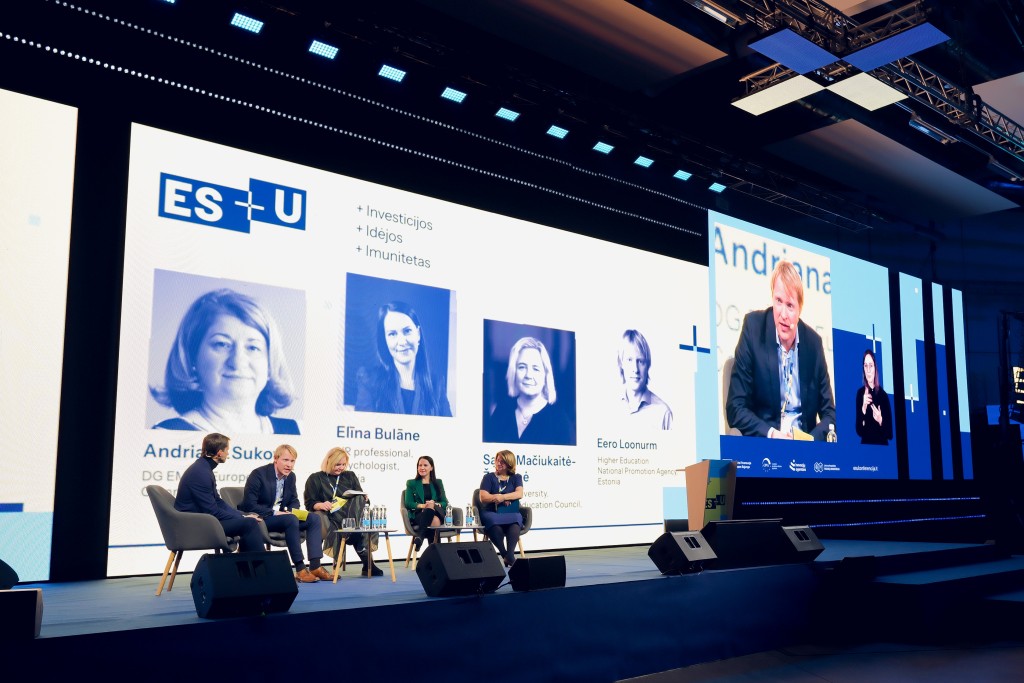
"The conference focused on the European Union's investments in the Baltic States and the opportunities offered to both the public and private sectors in the new funding periood," commented Eero Loonurm, who represented Estonia in the panel discussion on talent policy.
The purpose of the discussion was to share the three countries' visions and policies to attract talent to the Baltic countries in light of the global race for talent. In the thematic discussion "Talents in the Baltic Region: to Attract or to Maintain?" the main focus was on the relevance of talent for the Baltic region (and whether they differ in Estonia, Latvia and Lithuania) and which short-term and long-term decisions must be made to support the Baltic region to be more competitive region in the future.
Participants in the panel were Andriana Sukova (Deputy Director-General of the European Commission’s Directorate-General for Employment, Social Affairs and Inclusion, European Commission, Belgium), Elīna Bulāne (Organisational Psychologist, Career Counselor, Founder of www.yoursoulwork.lv, Co-host HRpodcast, Latvia), Saulė Mačiukaitė-Žvinienė (Professor at Vilnius University, Chair of the Education Council of Lithuania, Member of the Research Council of Lithuania, Lithuania) and Eero Loonurm (Head of Higher Education National Promotion Agency, Estonia). The moderator was Mantas Katinas (General Manager at Wargaming Vilnius, Lithuania).
"For the Lithuanian Ministry of Finance the three crucial challenges that Estonia, Latvia and Lithuania commonly face, are ageing society, shrinking population and growing need for skilled workers," commented Eero Loonurm, participant in the panel.
"Human capital is the basis of all decisions," commented Andriana Sukova from the European Commission.
Some notes from the discussion
- Every person in our labor market is important and valuable. We have taken the right steps to bring talent here.
- It is important to pay attention to talent in smaller areas outside the capital. Local areas play an important role in providing comfortable conditions for living and working.
- The private and public sector must cooperate well and see the opportunities that foreign talents can bring to the country's economy.
- It is important to offer people opportunities for further education and career development.
By 2050, the EU's working-age population is expected to decrease by 35 million and around 30% of the Europeans will be over 65 years old. According to the Lithuanian Ministry of Finance and Eurostat statistics, by 2050, the population is projected to decrease 19% in Lithuania, 23% in Latvia and 2% in Estonia.
Population in the Baltic Region is ageing and by 2035 the population over 65 will increase by 268% in Estonia, 614% in Lithuania and 188% in Latvia.
Additional information:
ES+U Conference: https://esukonferencija.lt/
Eurostat population projections: https://ec.europa.eu/eurostat/databrowser/view/tps00002/default/table?lang=en
Speakers at the 2023 conference: https://esukonferencija.lt/pranesejai/

