
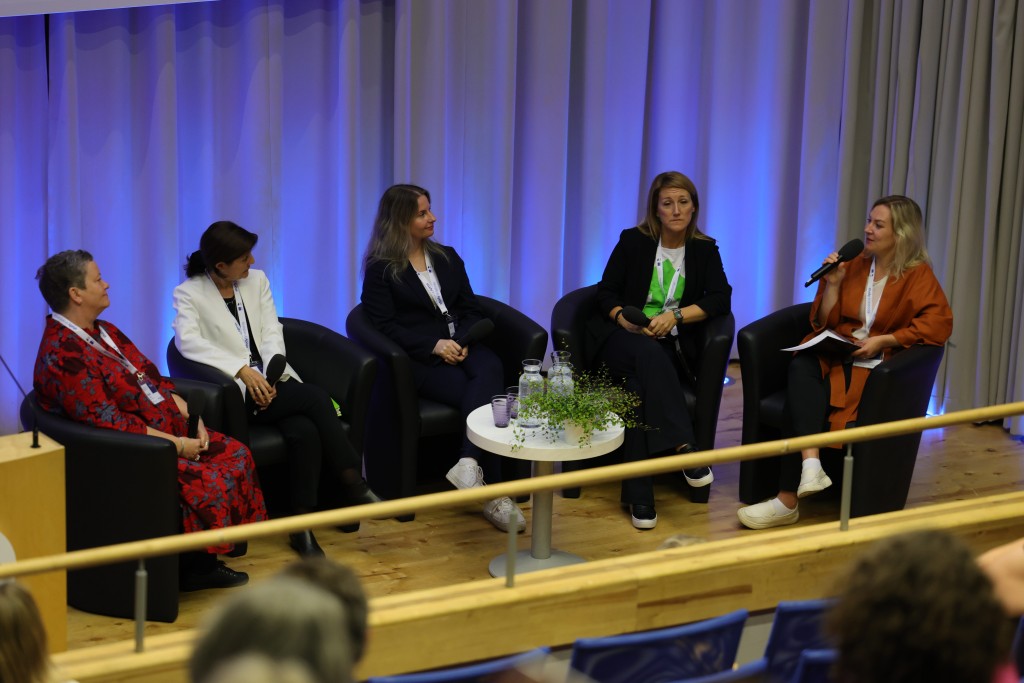
The conference focused on international cooperation between higher education institutions, as well as issues related to student and faculty mobility. The day was opened by the Ambassador of Norway to Estonia, Marius Dirdal, the Deputy Chancellor of the Ministry of Education and Research, Renno Veinthal, and the Director General of Harno, Jaak Raie, who all stressed the importance of international cooperation. Mr Dirdal noted that seven years ago the world faced different challenges, but it remains clear that higher education plays a key role in achieving global goals. The Estonian representatives reaffirmed that cooperation between Estonia and donor countries in the field of higher education has produced excellent results and that this partnership must continue in the future.
Speakers at the conference will come from the programme donor countries Norway and Iceland, as well as from the Ministry of Education and Research, the Education and Youth Board and higher education institutions.
Torill Iversen Wanvik, Senior Adviser at the Norwegian Directorate for Higher Education and Skills, stressed the importance of responsible internationalisation in his presentation. He noted that universities need to be aware of and manage the risks associated with international cooperation, especially in a tense global political situation. Iversen Wanvik also presented Norway's approach to the Guidelines for International Cooperation, which aim to ensure the security and ethics of academic work. "The starting point for such a document is a systematic assessment of how institutions can ensure the protection of aspects such as information, posts and infrastructure, as well as other values such as life and health, reputation, norms and principles," Iversen Wanvik stressed.
Heli Aru-Chabilan, Head of the Harno Centre for Educational Programmes, who presented Estonia's experience in organising student and staff mobility, pointed out that mobility is considered important and highly valued by participants. However, in times of economic crisis, there is a risk that international cooperation is not sufficiently valued and that opportunities are not fully exploited. It is certainly in the interest of our learners and educators to seize all such opportunities, as public funding for development is scarce.
Eero Loonurm, moderator of the day and Head of International Marketing at Harno Higher Education, highlighted why learning mobility is key to any international cooperation: "Learning mobility is the safest way to migrate and therefore the most important investment in the future."
The European Economic Area (EEA) Baltic Research Cooperation Programme has helped to promote cooperation between Estonian higher education institutions and their partners in Norway and Iceland. The aim of the programme, which ran from 2014-2024, was to support the internationalisation of Estonian higher education and strengthen cross-border academic links with the help of the funding countries - Norway, Iceland and Liechtenstein.
The programme funded ten higher education cooperation projects and one mobility project. The fields in which learning development was undertaken ranged from creative industries to bioinformatics. These initiatives created a strong partnership between Estonian higher education institutions and their counterparts in the donor countries. Faculty and staff broadened their knowledge, created professional networks and collaborated on projects of common interest. Students gained valuable international experience and broadened their future job prospects both in Estonia and abroad.
In addition to the open calls, the programme supported two pre-defined projects. One focused on the teaching of Norwegian language and literature at the University of Tartu, while the other aimed at improving the quality of teaching the inclusive education curriculum in cooperation between the University of Tartu and Tallinn University.
Project website: https://harno.ee/empnorra


